“The future well-being of the planet depends significantly on the extent to which we can nourish and protect not individuals, or even groups, but the generative processes of relating.” Kenneth J. Gergen
imagineacircle collaborative
imagineacircle is made up of me, Dr. Aaron Johannes and a number of partners, usually working on a few projects at the same time. I love working with others in collaboration and I love connecting with people doing good work, figuring out what they are doing, and helping them do more of what’s working. As I write, for example, we are working on a research project for a school district, getting ready to do a series of workshops on “welcoming diversity and difference” around the province, in talks about a series of community engagement events, hosting a new curriculum developed with and for people with intellectual disabilities which may become part of a community college offering, and writing two reports, one of which will be published as an article. Below are the biographies of some of the imagineacircle collaborative team members.
Aaron
Aaron Johannes
 “I slept and dreamt that life was joy. I awoke and saw that life was service. I acted and behold, service was joy.” Rabindranath Tagore
I am a lifelong learner and teacher in various ways, specializing in curriculum development for adults who support and care about people with intellectual disabilities as family members or staff, and for people with disabilities. I teach in the Disability and Community Studies faculty of Douglas College’s Child, Family and Community Studies. More recently I have been teaching, and acting as coordinator, in the CFCS Aboriginal Stream, which is an amazing little program that links up a number of programs by offering five alternative courses taught through an indigenous lens. While I am investigating our family’s hidden Metis heritage I am still thinking that through, so do not identify as indigenous. Instead, we bring in elders and other instructors so that most of the learning is through that pedagogical lens. It is a gift to be part of this and as one of the field’s experts said, indigenous pedagogy is good for indigenous students, but it is also good for all students. Indeed. And for their teachers.
For thirty years I have been a Director at Spectrum Society where I got to do a lot of very interesting things and work with some wonderful folks – families, people who received supports, friends, staff, managers, colleagues and consultants. All I ever wanted was a job that held my interest and it did that, and so much more. I have been a board member for PLAN, TLC in Kent Washington and a provincial advisor for B.C. People First. I currently volunteer in various ways for the Family Support Institute of B.C., which does amazing work by supporting peer families to support others who support people with disabilities.
I work as a consultant, facilitator, researcher and graphic facilitator sometimes, if the project interests me. This ranges from longer term work around organizational mission and meaning to day long workshops and graphic recording. I have had the joy and good luck of getting to meet people and facilitate workshops from the far North of B.C. to California and from Victoria to New York State, and all kinds of places in between.
At Douglas College and in my community based research and education my focus is on leadership, adult roles in community, social constructionism, communication, networks and belonging, teaching and creativity. My initial training was in Fine Arts at Capilano University, and then I studied Education and English Literature (focused on minority and marginalised lit) at Simon Fraser University. At Athabasca University I did a M.A. (Master of Arts in Integrated Studies) at one of what I think is the best interdisciplinary departments in Canada, focussed on Equity Studies and Education. I went on to my PhD studies within a partnership with the Taos Institute and the Vrije Universiteit Brussel. In both degrees I got to work with wonderful instructors and project supervisors – given that neither degree is something I thought I’d ever do, both experiences were phenomenal.
I really like the ideas of c0-learning, particularly as Paolo Freire talks about it, creating opportunities for dialogue and collaborative partnerships. This is what the Taos Institute, of which I am proud to be an Associate, is all about, and it is what VUB has stood for since 1834.
email me at aaron@imaginecircle.com
my twitter account is @imagineacircle
I love facebook – search for aaron johannes – and let me know who you are and what our mutual interests might be.
Barb Goode – emeritus

Barb Goode, author of The Goode Life: Memoirs of Disability Rights Activist Barb Goode, is an international expert on plain language and inclusive leadership. She takes many roles in our projects, always acting as a consultant and a voice for inclusion, but also facilitating in various ways. She joins us when she is able to.
Liz Etmanski

Nova MacLeod – on leave
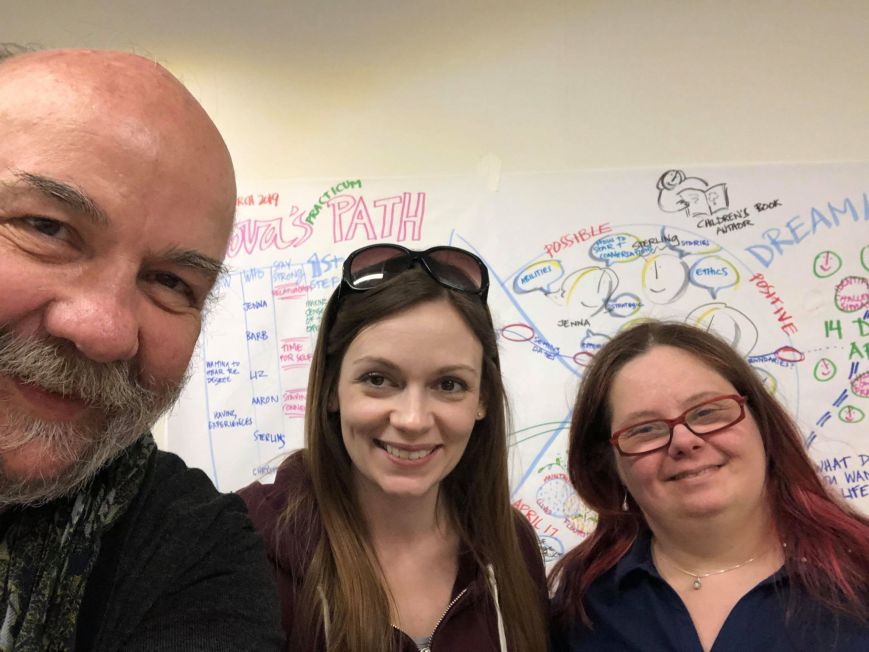 Nova is our Research Manager and wears many hats, often at the same time. She keeps us organized, tracks what we’re doing, makes sure that things happen when they are supposed to and is a superb interviewer in our research. She’s currently studying for her Child and Youth Care degree. Nova is on leave at the moment, and much missed!
Priscilla Omulo

‘ey’ ska’yel
(“good day” in HUL’Q’UMI’NUM’)
My name is Priscilla Omulo I am from Tsartlip, BC and currently live on Kwikwetlem territory.
My journey in life has given me many teachings. I have been blessed to have the knowledge and experiences I have and I hope to share this knowledge with others in hopes to support them through their journey. I share my knowledge and experiences through my work, writing and filmmaking.
My education is in Psychology, Mental Health and Addictions. I have worked in transition houses, youth shelters, as an addictions counselor, foster parent support, outreach counselor & much more.
I LOVE when I have an opportunity to combine my life experience, traditional teachings and education. This life work is not just what I do it is who I am.
Rhona Segarra M. Div. 
Rev. Rhona Segarra is passionate about people. Her mission is to add to the joy and peace in the world through strengthened relationships with ourselves and others. In her presentations, Rhona encourages people to claim their own independence and inherent worth, to grow in empathy and acceptance of others, and to remain connected with each other while allowing for differences. These strategies have the power to enrich all of our relationships. Rhona has presented workshops at several organizations including the Family Support Institute training weekend, the ArtBrain project, Spectrum Society training day and Langley Men’s Anger Management group.
Rhona was born in Cape Town, South Africa and moved to Canada in 1977. She holds a degree in Economics from the University of Waterloo and a Chemical Engineering Technology diploma from Lambton College in Sarnia Ontario. In her “previous” life, Rhona was the general manager at The Party Bazaar for 10 years, a manager at Staples, and a district manager for Rogers Video. She also worked for Imperial Oil for 15 years as a research technologist and a district manager.
A “Connection Practice” and “Healthy Congregations” facilitator, Rhona holds a Masters of Divinity and is an ordained Unity minister. She leads the spiritual community at Unity of New Westminster, BC.
Rhona is blessed with a wonderful family: a loving husband Walt, brilliant son David, and amazing parents, brothers and sisters.
Shelley Nessman

Shelley’s passion is supporting people to discover, nurture and share their gifts, skills, and abilities. Her experience as a facilitator and planner has helped her to understand that when a person and their network combine their dreams with a plan for action – anything is possible!
Two significant experiences changed everything about the way Shelley views “the work”.
First was an opportunity early in her career to be trained by Jack Pearpoint and Marsha Forrest as a PATH facilitator (followed by life altering training from Dave and Fay Wetherow).
Second has been the privilege of sharing her home with people who experience disability. Life sharing has been a deep personal learning experience that shows up in everything she does.
Recently Shelley has worked for Spectrum Consulting where she was a consultant on strategic initiatives and Associate Director of person centered planning.
Prior to this she was the Self Advocate advisor for Community Living British Columbia.
Deeply listening to someone and supporting them to identify and express their gift changes us all- and is the reason Shelley has always said: “This is a peace movement- it’s all about love”.
Somewhere our work took us recently was to a class of Metis students who are learning the art and craft of community support, where Eilidh demonstrated planning methods that would be useful to them.
You can also find Shelley at her other consulting site, http://incompanyofothers.com
Email:
Eilidh Nicholson

Eilidh is a PATH facilitator of choice for many people and has been developing working expertise in world cafes and dialogues. She regularly hosts inclusive, dialogic events through Spectrum Society.
Somewhere our work took us recently was to work with a group of about fifty people who are passionate about inclusive education, where Eilidh led a world cafe focused on three questions the group wanted to talk more about. The last of these was: how do we ensure all of our students are seen? [for their gifts and contributions, as part of their families and networks, as members of their community, as future leaders].
Laurel Klassen Charnetski

Laurel is one of the rare leaders in the field of disability supports who has an experience of working with adults, in various roles ranging from support worker to program manager and innovator, to Executive Director, and then working within the school system.
Recently Laurel was part of co-facilitating PATH training with a group that included many teachers, where she was able to demonstrate how we can use person centred planning methods to inform IEPs and similar working documents.
Other folks we have worked with and sometimes call in…
 ImagineACircle
Congratulations your blog has just won the Liebster award. 🙂
🙂 Very Cool Blog!
What an inspiring story! As a fellow educator and visual storyteller I resonate with your journey. Thank you for this!
Hi Aaron,
I loved reading your story and have recently bought 101 Ways to Make Friends. I am an Independent Facilitator working in Kitchener, Ontario. I am also a Connector with a PLAN affiliate, a mother of two daughters (one who is 20 and has several labels), visual art educated and working on becoming a better graphic facilitator. I’ll be checking in with you from time to time to learn more about what you do and how I can grow in my craft(s). Thanks for doing what you do.
Wendy
thanks Wendy – do you know my friend Chris Lee; he’s also doing some work for PLAN, in Toronto I think. nice to hear from you! aaron
Lovely Aaron, thank you.
If you ever get near Charlotte, NC come visit Aaron. marye.ulrich1@gmail.com I’d love for you to meet our Aaron 🙂
that would be so great! hope you are well 🙂
Very cool Aaron! Continue the journey with all of us!
Dear Aaron,
I hope this message finds you well.
I am curating an exhibition in London at the end of September on the legacies of eugenics. Here’s the link:
https://wienerholocaustlibrary.org/exhibition/we-are-not-alone-legacies-of-eugenics-1921-2021/
It is meant to coincide with the centenary of the Second International Eugenics Congress held in NY in 1921.
I want the last section of the exhibition to be about anti-eugenics and anti-eugenic activism. Reading about the “The Eve Decision” of 1986 and wanting to included it I came across the graphic image you created based on Barb Goode’s story (https://cic.arts.ubc.ca/the-eve-decision-1986/) and I immediately knew it would be a great addition to the our exhibition. Will you allow us to use it?
with best wishes
Prof Marius Turda
Oxford Brookes University
Oxford
mturda@brookes.ac.uk
thanks, Marius – I will talk to Barb this afternoon but I think this sounds great and she continues to want to inform people about these ideas so I’m sure it will be fine. the show looks like it will be a great way to foster important conversations. Aaron